
Book Appointment Now

8 Best Butcher Knives for 2026: Cut Smarter, Prep Faster

A sharp butcher knife changes the whole rhythm of meat prep, turning a tedious session of hacks and scrapes into something closer to honest, confident work. The picks below cover serious BBQ breakdowns, casual home carving, and everything between, so you can match a blade to the way you actually cook. Each option was chosen for what it does well in the kitchen, not for flashy specs alone.
The Leading Options At A Glance
PickWhy We Picked ItBest ForAction
Editor’s Choice
Cutluxe Butcher Knife Set (3-Piece)
Three-blade pitmaster bundle
BBQ breakdowns and trimming

Premium Pick
Sunnecko 8-Inch Damascus VG10 Chef Knife
Layered Damascus with VG10 core
Detail-oriented home cooks

Everyday Favorite
Sunnecko 8-Inch Japanese Chef Knife
Pakkawood comfort, Japanese style

Design Standout
Sunnecko 7-Inch Nakiri Knife
Flat-edge vegetable specialist
Vegetable-heavy prep sessions
Heavy Duty Pick
Sunnecko 7-Inch Meat & Vegetable Cleaver
Tall blade for through-cuts
Tough produce and bone-in tasks

Feature Rich
Sunnecko 7-Piece Damascus Knife Block Set
Full block with VG10 core
Outfitting a new kitchen

Professional Pick
Victorinox Fibrox 8-Inch Curved Breaking Knife
Trusted pro workhorse design

Outdoor Ready
TIVOLI 6-Piece Butcher Knife Set
Game processing with sharpener
Why These Options Stand Out
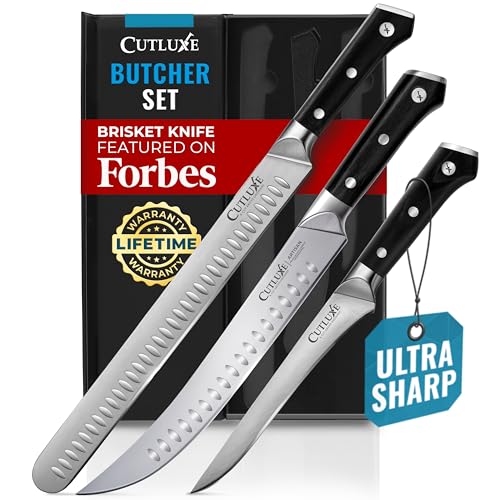
Breaking down a whole brisket or working through primals at home calls for more than a single chef’s knife, and that’s where the Cutluxe set earns its place. You get a long 12-inch slicer for trimming bark and portioning brisket, a curved 10-inch breaking cimeter (a blade with a forward-curving belly designed for sweeping through roasts) for going through cartilage, and a nimble 6-inch boning knife for working around bone and silver skin.
Compared to the Sunnecko picks that follow, this bundle is purpose-built for BBQ rather than general kitchen duty. Pitmasters running a backyard offset smoker benefit most, since each blade covers a different stage of the breakdown without forcing you to swap knives constantly.
The Upside
- Three purpose-specific blades cover trimming, breaking, and boning in one purchase
- Long 12-inch slicer handles full brisket flats with fewer strokes
- Curved cimeter profile rolls naturally through roasts and primals
- Shorter boning knife keeps control tight around joints and ribs
- Replaces a drawer full of mismatched blades for BBQ day
Things To Consider
- Storage takes more room than a single chef’s knife
- Longer blades feel unwieldy in a small home kitchen
- Steel will need routine honing (realigning the edge on a rod) to stay BBQ-ready
Who Will Love This
Backyard pitmasters who break down whole briskets, pork shoulders, and primals on a regular basis will appreciate the purpose-built trio.
Swap It Out When
Home cooks focused on weeknight meal prep will find the Sunnecko 8-Inch Japanese Chef Knife (B0B3DM77BQ) a more versatile single-blade answer for daily vegetable and meat work.
Where the Cutluxe set favors BBQ specialists, this Sunnecko is a refined all-rounder for cooks who care about edge geometry and visual finish. The blade is built from 67-layer Damascus steel (multiple thin steel layers forge-welded into a patterned, hard-edged core) wrapped around a VG10 stainless core, and the listed 10-12 degree edge sits firmly in slicing-knife territory. That acute angle helps the blade glide through tomatoes and proteins with minimal crushing.
You may find this knife rewards cooks who already keep a sharpening stone nearby, since thin edges demand more frequent touch-ups. Owners who enjoy cooking as craft and want one beautiful blade to anchor the block will get the most out of it.
A Few Highlights
- 67-layer Damascus construction with a hard VG10 cutting core
- Razor-thin 10-12 degree edge for clean protein slicing
- Patterned finish resists corrosion in daily use
- Single 8-inch blade handles most prep tasks
Worth Noting
- Thin edge needs regular whetstone maintenance
- Premium construction commands a higher investment than basic stainless
- Not designed for hacking through bone
Feature Snapshot
Right Fit For
Detail-oriented home cooks building a premium block around a single hero blade will find this Sunnecko earns its keep.
Reach For A Different Pick When
Outfitting a whole kitchen from scratch is easier with the Sunnecko 7-Piece Damascus Knife Block Set (B0DJGDXWBW), which matches the Damascus look across a full set.
This is the most accessible of the Sunnecko options, a single Japanese-style 8-inch chef knife built around high-carbon stainless steel and a pakkawood handle (a resin-impregnated hardwood that resists moisture). The 12-15 degree edge lands between the razor-thin Damascus blade above and heavier Western knives, which makes it more forgiving for cooks still building sharpening habits. You also get a sheath, useful for tossing it in a drawer without a block.
Compared to the multi-piece Cutluxe set, this is a one-knife solution for everyday dinner prep. It works well for cooks who want Japanese-style slicing geometry without committing to full Damascus layering.
Where It Excels
- 12-15 degree edge balances sharpness with durability
- Pakkawood handle offers a warm, secure grip
- Included sheath protects the edge in shared drawers
- Makes a solid gift for newer cooks building a kit
Trade Offs
- High-carbon stainless still benefits from hand-drying after washing
- Less visual flair than Damascus-clad options
Best Suited To
Weeknight cooks who prep a mix of vegetables and proteins and want one reliable Japanese-style blade will get along with this Sunnecko for years.
Not Your Match When
Cooks breaking down whole primals need the longer reach of the Cutluxe Butcher Knife Set (B0DDPYQTXR) rather than a single 8-inch chef knife.
A nakiri is a Japanese knife with a straight, squared-off edge, built for clean downward cuts through vegetables and boneless proteins. This 7-inch Sunnecko version uses that classic profile with a 12-degree hand-polished double-bevel edge, giving you crisp, flat cuts on cabbage, herbs, or trimmed steaks without the rolling motion a chef’s knife demands. It doubles as a light cleaver-style tool for boneless meat.
Where the Damascus VG10 knife above leans into Western protein slicing, this one is all about produce. The honest read is that it’s a specialist’s tool, and the right cook will reach for it constantly.
Useful Highlights
- Flat edge keeps cuts clean and uniform on vegetables
- Lightweight profile reduces wrist fatigue during long prep
- 12-degree edge handles paper-thin herb and garlic work
- Distinctive silhouette stands out in any block
Points To Note
- Not suited for breaking down bone-in cuts
- Works best as a second knife alongside a chef’s blade
Whose Shelf It Belongs On
Vegetable-focused home cooks prepping big salads, stir-fries, or mirepoix will love how fast this knife moves through dense produce.
A Better Fit Elsewhere
For breaking down whole proteins, the Victorinox Fibrox 8-Inch Curved Breaking Knife (B0019WXEO2) is the more honest tool for that specific job.
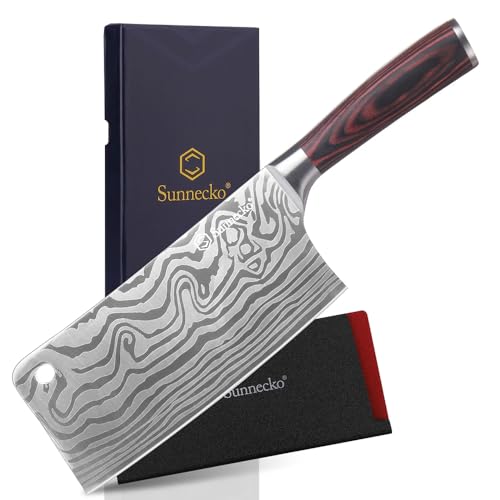
Chinese-style cleavers (tall, rectangular blades that ride up and down rather than rocking) are a different beast from Japanese nakiri, and this 7-inch Sunnecko leans into that “tall blade, all-purpose chops” approach. The high-carbon steel is built for daily prep, and the profile is friendly for cooks who chop big piles of greens or split boneless meat blocks without fuss.
It pairs naturally with the nakiri above for cooks who want both Japanese and Chinese silhouettes in their kit. People who cook with thick, dense produce like squash or pineapple will appreciate the extra blade height.
Where It Delivers
- High-carbon blade holds up to daily prep
- Tall profile gives knuckle clearance for fast chopping
- Handles thick vegetables and boneless meat with one motion
- Sturdy build feels planted in the hand
Some Limits To Know
- Heavier than a Western chef’s knife, which may tire smaller hands
- Requires hand-drying to prevent corrosion on the carbon steel
- Not a substitute for a real bone-chopping cleaver
Quick Facts
Made For
Home cooks who batch-prep hearty vegetables, garlic, and boneless proteins will appreciate this cleaver’s daily versatility.
Skip It When
Smaller hands or tight galley kitchens are better served by the lighter Sunnecko 7-Inch Nakiri Knife (B0DJGX8NJ9).
Outfitting a kitchen from zero usually means buying a chef’s knife, a paring knife, a slicer, and a block, and that’s roughly what this Sunnecko 7-piece set delivers in one box. The blades share a forged Damascus build with a VG10 core, and the included wood block keeps everything organized on the counter. It’s a clean solution for new apartments, wedding registries, or anyone replacing a mismatched drawer of old knives.
You may find the sheer number of pieces overkill for a one-pan cook, but the consistency across the set is the real selling point. Every blade shares the same steel and edge geometry.
Noteworthy Benefits
- VG10 core across every blade for consistent performance
- Forged Damascus finish ties the set together visually
- Wood block keeps the counter organized out of the box
- Replaces piecing together knives over time
Where It May Fall Short
- Takes up dedicated counter space
- More pieces to maintain than a single chef’s knife
- Thinner Damascus edges still want regular stropping (refreshing the edge on a leather or honing rod)
Perfect Match For
Newlyweds, first apartments, and anyone replacing a tired old knife drawer will get years of use from a matched set like this.
Look Elsewhere When
Solo cooks or minimalists are better served by the single Sunnecko 8-Inch Japanese Chef Knife (B0B3DM77BQ) and a small paring knife.
Victorinox’s Fibrox line is a fixture in butcher shops and meat rooms, and the 8-inch curved breaking version is the workhorse of the family. The curved belly rolls naturally through roasts, primals, and poultry, while the Fibrox handle stays grippy even with wet hands. The trade-off is a no-frills, utility-first design that trades Damascus looks for honest, easy-to-sharpen steel.
Unlike the Sunnecko sets, this is a single-purpose tool that does one job extremely well. Hunters, small processors, and serious home butchers tend to keep a knife like this on the magnetic strip for years.
Points In Its Favor
- Proven design trusted in commercial meat rooms
- Textured Fibrox handle stays secure with wet or greasy hands
- Curved profile tracks through cartilage and joints smoothly
- Simple stainless steel is easy to maintain and resharpen
Honest Caveats
- Not a multipurpose blade for vegetable prep
- Plastic handle lacks the visual warmth of wood or pakkawood
Feature Card
Built With In Mind
Serious home butchers and small-shop processors who break down whole animals or large primals will appreciate the proven design.
Consider Something Else When
Hunters dressing elk or deer in the field will want the all-in-one TIVOLI 6-Piece Butcher Knife Set (B0FM7Q1BK5) with its dedicated sharpener rod.
This is the most field-oriented bundle in the roundup. The TIVOLI set pairs a 10-inch bullnose butcher knife, a 10-inch slicer, an 8-inch slicer, a 6-inch straight breaking knife, a 6-inch curved breaking knife, and a 7-inch sharpener rod, which covers everything from rough breakdown to final portioning without swapping sets. The included rod matters more than it sounds when you’re far from a whetstone.
Compared to the Cutluxe trio, this is broader coverage aimed at game rather than BBQ brisket. Hunters and field-to-table cooks get a full workflow in one case.
The Case For It
- Six blades cover every stage of game processing
- Bullnose and curved/straight breaking knives handle varied cuts
- Included sharpening rod keeps edges field-ready
- Long slicers portion roasts cleanly for the table
Worth Bearing In Mind
- Larger kit demands more storage than a single blade
- Specialty focus means it overlaps with kitchen tools you may already own
Key Product Details
Who Should Grab It
Hunters processing deer, elk, or wild hog at home or at camp will appreciate a complete breakdown kit in one case.
Where A Sibling Pick Shines
Backyard pitmasters focused on brisket and pork shoulder are better served by the more focused Cutluxe Butcher Knife Set (B0DDPYQTXR).
Picking a Butcher Knife That Fits Your Kitchen
Match the Blade to the Job
The first decision is whether you want a single versatile chef’s knife or a purpose-built specialty blade. A 7- or 8-inch chef’s knife, like the Sunnecko 8-Inch Japanese Chef Knife, handles vegetables, herbs, and boneless proteins with ease, while a curved breaking knife, like the Victorinox Fibrox 8-Inch, exists for going through cartilage and primals. Buying the wrong profile is the most common regret, since a Western chef’s knife simply can’t mimic a cleaver’s downward chop, and a nakiri (a flat-edged Japanese vegetable knife) can’t break down a shoulder blade.
Understand Steel and Edge Geometry
The two specs that change daily ownership are steel type and edge angle. Damascus-clad blades with a VG10 core hold a finer edge for longer but demand more careful sharpening. High-carbon stainless is easier to maintain and forgiving for newer cooks. Edge angles between 10 and 15 degrees favor precision slicing, while heavier Western edges around 20 degrees tolerate rougher contact with bones and frozen food.
Consider Weight, Balance, and Handle
A knife that fights your hand will end up in a drawer, so handle geometry matters as much as steel. Pakkawood handles, like the one on the Sunnecko Japanese Chef Knife, offer a warm, secure grip for extended prep, while textured polymer handles, like the Victorinox Fibrox, shine in wet or cold conditions like a butcher shop. Pick what matches your environment.
Smart Choices Before You Add to Cart
Common Buying Mistakes Worth Dodging
The biggest trap is treating “butcher knife” as a single product when it’s really a category. A 12-inch brisket slicer and a 6-inch boning knife do completely different jobs, and a multipurpose chef’s knife can’t replace either. Match the knife to the protein you actually handle most often.
When Paying More Pays Off
Higher-tier options, like the Sunnecko Damascus 8-Inch Chef Knife with its VG10 core, earn their keep through edge retention and corrosion resistance. You’re paying for steel that holds a working edge longer between sharpenings and a build that survives daily use. For cooks who reach for a knife every night, that translates to less maintenance and more consistent cuts over years of ownership.
Frequently Asked Questions
What’s the difference between a breaking knife and a butcher knife?
A breaking knife is a curved-blade tool designed to separate primals and go through cartilage, while “butcher knife” is a broader term covering slicers, boning knives, cleavers, and breaking blades in one category. Most cooks want a slicer and a chef’s knife, not a dedicated breaking knife, unless they process whole animals regularly.
How often should a butcher knife be sharpened?
Honing (realigning the edge on a rod) every couple of uses keeps the blade working between sharpenings, while a full whetstone sharpening every few months handles actual edge renewal. Higher-end steel holds its edge longer, but no knife stays sharp forever.
Can one knife handle both meat and vegetables?
A versatile chef’s knife, like the Sunnecko 8-Inch Japanese Chef Knife, handles boneless proteins and produce without cross-contamination when wiped between uses. For bone-in meat or large roasts, a longer slicer or breaking knife is the right tool.
What’s the safest way to store a sharp knife?
A wood block, magnetic strip, or included sheath keeps edges off other utensils and out of harm’s way. Tossing a sharp knife loose in a drawer is the fastest way to dull the edge and risk a cut.
Are expensive butcher knives worth the investment?
Premium steel, like VG10 or layered Damascus, holds an edge longer and resists corrosion, which matters for daily cooks. For occasional use, a mid-range stainless blade may serve just as well, and you can always upgrade later.
Closing Remarks
A good butcher knife should disappear into the work, letting the ingredients lead the moment rather than the tool. Start with the protein and prep style you cook most often, choose a blade that matches, and invest in a basic whetstone or honing rod to keep it honest. The right knife, used well, will outlast several rounds of drawer upgrades and quietly become the one you always reach for.
