
Book Appointment Now

8 Best Gravity Water Filter Systems for 2026: No Plumbing Needed

Most households don’t realize how much of their daily water routine depends on pressure and pipes until they want filtered water somewhere neither exists. A gravity water filter system solves that quietly: pour water in the top chamber, let gravity pull it through the filter media, and draw clean-tasting water from the spigot below. That makes these systems useful far beyond the kitchen counter, from rental apartments where drilling isn’t an option to cabins, RVs, and campsites. The eight systems below cover both ends of that spectrum, including countertop stainless steel units for families and a packable option for trail use.
The Shortlist At A Glance
PickWhy We Picked ItBest ForAction

Editor’s Choice
Waterdrop TK-A Gravity Water Filter System 2.25G
Certified filtration performance
Families of four

Feature Rich
Purewell PW-KS 2.25G Gravity Water Filter System
Visible water level window
Busy household counters

Upgrade Pick
Purewell PW-KS-CF 2.25G Gravity Water Filter System
Eight-stage filter stack
Fluoride-conscious homes

Compact Choice
Purewell PW-MKS-CF 1.5G Gravity Water Filter System
Space-saving footprint
Small kitchens and couples
Traveler’s Choice
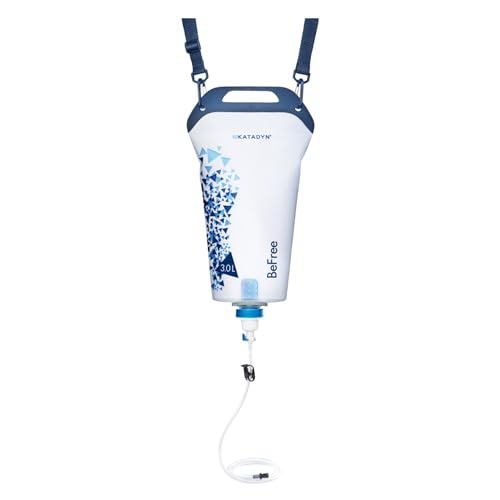
Katadyn BeFree Gravity Water Filter 3L
Packable trail design
Backpackers and campers

Value Pick
Waterdrop Gravity Water Filter Replacement for Berkey BB9-2 & PF-2
Budget-friendly refills
Existing system owners
Heavy Duty Pick
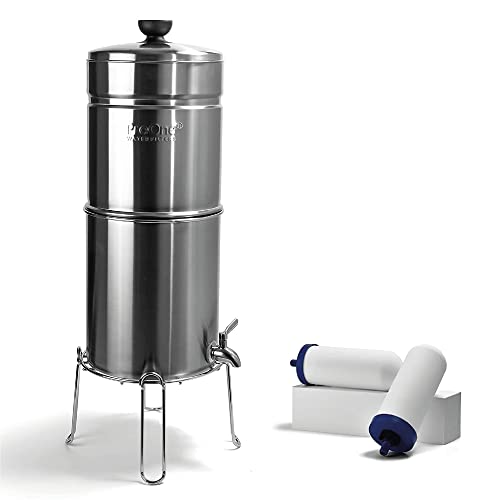
ProOne Big+ Gravity Water Filter System
Three-gallon capacity
Large households and RVs
Well Rounded Pick
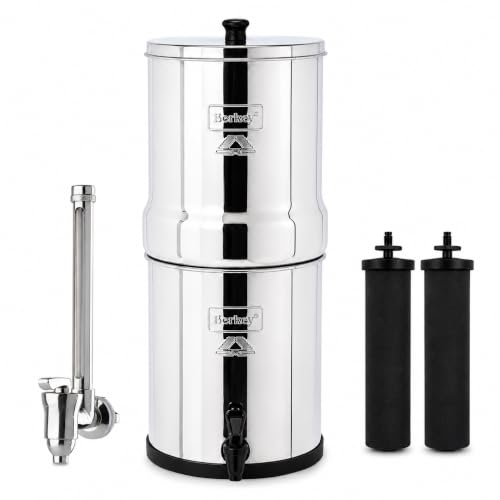
Big Berkey 2.25 Gal Water Filter with Black Elements
Established design
Homes, offices, and RVs
More Details On Our Top Picks
The King Tank earns its place here on paperwork as much as hardware: it carries NSF/ANSI 42 and 372 listings, third-party standards covering chlorine reduction and lead-free materials. In plain terms, that means the claims on the box have been checked by an outside lab rather than resting on marketing alone.
The 2.25-gallon lower chamber suits a family of four going about a normal day of drinking, coffee, and cooking. A metal spigot replaces the plastic taps common at this level, which tends to hold up better over years of daily use.
Strong Points
- Third-party NSF/ANSI 42 and 372 listings back up the chlorine and lead-reduction claims
- Natural coconut shell carbon media improves taste noticeably in municipal tap water
- Metal spigot resists the cracking and dripping owners often report with plastic taps
- No electricity or plumbing, so it works in rentals, cabins, and campers alike
Things To Consider
- Gravity flow runs slower than a faucet filter, so plan to fill pitchers ahead of mealtimes
- The two included carbon elements need periodic scrubbing and eventual replacement to keep flow rates healthy
Key Specs
Who It Suits Best
A family of four on city water who wants independently verified chlorine and lead reduction without touching their plumbing.
Where Another Pick Suits Better
Trail users should look at the Katadyn BeFree Gravity Water Filter 3L instead, since its collapsible flask travels far better than any steel canister.
Small details separate good gravity filters from annoying ones, and Purewell’s transparent water-level window is exactly that kind of detail. You can check remaining water at a glance instead of lifting the lid mid-cooking, something every busy kitchen will appreciate once dinner’s underway.
Inside, a three-stage composite cartridge pairs activated carbon with a hollow-fiber ultrafiltration membrane rated at 0.01 microns. To put that pore size in context, it’s fine enough to strain particles far smaller than most bacteria, while carbon handles the chlorine taste side. Compared with the Waterdrop TK-A above, this one trades third-party certification paperwork for that finer membrane rating.
What We Like
- Clear sight window lets you monitor levels without opening the system
- 0.01-micron UF membrane adds a physical barrier beyond carbon alone
- Included stand raises the spigot so tall glasses and bottles fit underneath
- Stainless steel housing wipes clean and doesn’t hold odors the way plastic can
Worth Noting
- Two cartridges mean fewer refill purchases, but replacement availability varies by region
- UF membranes clog faster in sediment-heavy well water, so pre-straining cloudy source water helps
Made For
Households on treated municipal water who value convenience features like the sight window and a raised dispensing height.
Consider Something Else When
Shoppers prioritizing lab-verified certifications will find the Waterdrop TK-A’s NSF/ANSI listings a stronger fit for the same footprint.
This is the PW-KS from the previous section with a deeper filter stack. Where that model runs three stages, this version stacks eight, adding media targeted at fluoride alongside the same 0.01-micron hollow-fiber membrane and carbon treatment. Four cartridges ship in the box rather than two, doubling the filtration surface inside the same 2.25-gallon body.
More surface area matters in practice because it keeps flow speed reasonable even as the elements age. The sight window and stand carry over unchanged, so day-to-day handling feels identical to its sibling.
Highlights
- Eight-stage media addresses fluoride along with chlorine taste and odor
- Four cartridges provide greater combined surface area for steadier flow
- Sight window and included stand make daily refills low-friction
- Stainless steel construction suits open countertops and RV galleys
Minor Gripes
- Four-element setups cost more to replenish when replacement time arrives
- Priming multiple new cartridges before first use takes patience
- Fluoride media has a finite lifespan and needs tracking separately from the carbon stages
Quick Facts
Right Fit For
Households specifically concerned about fluoride in their supply who still want the simplicity of a countertop gravity unit.
Swap It Out When
Larger families draining a 2.25-gallon tank twice daily may prefer the ProOne Big+’s three-gallon reservoir instead.
Not everyone needs a family-sized tank sitting on the counter. This smaller sibling in Purewell’s lineup trims the lower chamber to 1.5 gallons while keeping the full eight-stage cartridge set, the 0.01-micron membrane, and the sight window from the larger PW-KS-CF reviewed above.
The result is a unit that fits comfortably beside a coffee maker or on a cramped apartment counter, and it’s light enough to move between the kitchen and an office break room without much effort. Couples and solo dwellers rarely drain 2.25 gallons before refreshing it anyway, so the smaller tank costs little in real-world convenience.
Upsides
- Reduced 1.5-gallon footprint fits narrow counters and small apartments
- Retains the complete eight-stage fluoride-targeting cartridge set
- Sight window remains, so monitoring stays effortless despite the smaller body
Softer Spots
- Lower capacity means more frequent top-ups for households of three or more
- Four cartridges in a compact body leave less air gap, so priming takes care
Who Will Love This
Solo dwellers and couples in apartments or dorm-style kitchens who want serious filtration without sacrificing counter space.
Another Choice May Suit
Families of four should step up to the Purewell PW-KS-CF 2.25G, whose larger tank halves the number of daily refills.
Everything else on this list lives on a counter. The BeFree goes in a backpack. Hang the soft 3-liter flask from a branch, fill it from a stream or lake, and gravity feeds water through the EZ-Clean Membrane into your bottle below while you set up camp.
The clever part is maintenance: swish the filter in water or shake the capped flask to clear debris, no tools or backflush kit required. Hikers on multi-day trips commonly report that this field-cleanable design keeps flow rates usable far longer than sealed cartridges. One honest trade-off, it’s built for backcountry sources, not chlorinated tap polishing, so it complements rather than replaces a home unit.
Bright Spots
- Collapsible 3-liter flask packs down far smaller than any steel system
- EZ-Clean Membrane rinses clear of debris in seconds, no tools needed
- Hands-free hanging setup filters water while camp chores get done
- Lightweight build barely registers in a loaded pack
Points To Note
- Soft flask construction demands gentler handling than stainless steel around rocks and zippers
- Designed for natural water sources, not everyday countertop duty
At A Glance
Who Should Grab It
Backpackers, thru-hikers, and overlanders who need passive filtration at camp and zero bulk during the day.
Look Elsewhere When
Kitchen-first shoppers should choose the Waterdrop TK-A, whose steel tank and spigot are built for permanent countertop service.
This entry isn’t a system at all, and that’s the point. It’s a replacement element set shaped to drop into existing gravity housings that accept BB9-2 black filters and PF-2 fluoride posts, covering Travel, Big, Royal, Imperial, and Crown sized chambers as well as Waterdrop’s own gravity-fed tanks.
For anyone already owning one of those housings, aftermarket elements are where long-term ownership costs live. Running a compatible set typically softens the ongoing expense compared with sticking exclusively to first-party refills. Waterdrop positions itself as an independent brand here, not affiliated with the original housing maker, worth knowing before you order.
Plus Points
- Combines carbon elements and fluoride post-filters in one purchase
- Fits a wide range of common gravity housing sizes, from Travel to Crown
- Gives existing system owners a second sourcing option for refills
Small Caveats
- Fit and flow depend on your specific housing generation, so double-check compatibility first
- As an independent-brand element, performance figures come from the manufacturer rather than a shared testing standard
Built With In Mind
Current owners of BB9-2-compatible gravity housings hunting for a practical refill path that doesn’t lock them into one supplier.
Reach For A Different Pick When
First-time system shoppers should skip straight to the Big Berkey 2.25 Gal package below, which pairs the housing and elements together out of the box.
Capacity is this unit’s headline. At three gallons, the Big+ holds roughly a third more water than the 2.25-gallon Waterdrop and Berkey units elsewhere on this list, which translates into fewer refills for a household of five or six. The stainless steel dispenser suits both a kitchen counter and an RV bay.
Its IAPMO listing covers lead, total PFAS, microplastics, and chlorine taste and odor, a notably modern contaminant list. PFAS, sometimes called forever chemicals, are industrial compounds that concern many municipal-water drinkers, and few gravity systems at any level publish third-party results against them. Beneficial minerals such as calcium stay in the finished water, per the manufacturer.
Reasons To Buy
- Three-gallon reservoir cuts refill frequency for larger households
- IAPMO-listed performance against lead, total PFAS, and microplastics
- Beneficial minerals like calcium remain in the dispensed water
- Stainless steel body transitions cleanly between home and RV use
Honest Caveats
- The taller filled weight makes moving a full unit a two-handed job
- Replacement filters arrive as a two-pack, so budget for paired purchases
- Larger footprint demands more counter depth than the Purewell compact models
Details At A Glance
The Right Fit
Large families, shared households, and RV owners who empty smaller tanks too quickly and want verified PFAS coverage.
Not Your Match When
Tight counters favor the Purewell PW-MKS-CF 1.5G, which delivers similar multi-stage filtration in a much smaller body.
This is the configuration many people picture when gravity filtration comes up: the classic stainless steel chamber, 2.25-gallon capacity, two Black Berkey elements installed, and a upgraded deluxe spigot replacing the standard tap. Nothing here needs power, pressure, tools, or plumbing, which is why the design shows up everywhere from apartments to offices to off-grid cabins.
Compared with the Waterdrop TK-A, you’re choosing brand heritage and a deep accessory ecosystem over published NSF listings. Owners commonly report elements lasting a long time under typical household use, though actual lifespan always depends on your source water quality.
Standout Traits
- Complete ready-to-run package with two elements and a deluxe spigot fitted
- Runs entirely on gravity, no electricity, pressure, or installation required
- 2.25-gallon size covers drinking, coffee, tea, and cooking for a household
- Long track record means accessories and advice are easy to find
Areas To Watch
- Stainless lid and chamber surfaces show fingerprints and water spots in bright kitchens
- Element priming before first use trips up some first-time owners
- Deluxe spigot, while sturdier than stock, still deserves gentle handling
Core Details
Whose Shelf It Belongs On
Anyone wanting a proven, widely supported gravity platform for a home, office, or RV with minimal setup fuss.
Where A Sibling Pick Shines
Documentation-focused shoppers may favor the Waterdrop TK-A, whose NSF/ANSI 42 and 372 listings offer independent verification this package doesn’t publish.
What Matters Most Before Choosing Gravity Water Filter Systems
Match Capacity To Your Household
A 1.5-gallon tank sounds adequate until four people run it through coffee, cooking, and refillable bottles. As a rough guide, plan on half a gallon per person per day for drinking alone. Couples do fine with compact bodies, while families of four or more should start at 2.25 gallons or step up to a 3-gallon reservoir like the ProOne Big+.
Read The Filtration Claims Carefully
Carbon media improves taste and cuts chlorine; ultrafiltration membranes add a physical barrier measured in microns; specialized media targets things like fluoride. Third-party listings such as NSF/ANSI 42 and 372 or IAPMO verification tell you an outside lab checked the claims. Without them, you’re relying on manufacturer data alone, which isn’t disqualifying but deserves a closer read.
Think About Source Water First
Treated municipal supplies mostly need chlorine and taste improvement. Well water brings sediment that clogs fine membranes quickly, and rural sources may justify broader-spectrum media. Matching the filter type to what’s actually in your water prevents wasted money on stages you don’t need.
Factor In Ongoing Ownership
Every element eventually needs replacing, and multi-cartridge systems cost more per cycle. Spigots, gaskets, and priming routines all affect daily satisfaction, so a slightly simpler system often wins on long-term ease.
Key Considerations Across These Picks
Traps First Timers Fall Into
The most common misstep is buying on capacity alone and ignoring filter media. A big tank with basic carbon won’t address concerns a finer membrane would. Another frequent slip is skipping the compatibility check on replacement elements, then discovering your housing accepts only certain sizes. Measure your counter depth too, since 3-gallon units eat more space than product photos suggest.
The Case For Spending Up
Higher-tier systems earn their cost through independent certifications, metal hardware, and larger element surface area. Verified coverage for lead or PFAS matters most where source water quality is uncertain. Paying more also buys steadier flow as filters age, which is the difference you feel every single morning.
Frequently Asked Questions
Do gravity water filter systems need electricity?
No, they rely entirely on gravity pulling water through the filter media. That makes them usable anywhere, including off-grid cabins and RVs.
How fast do these systems filter water?
Flow depends on element count, surface area, and how full the upper chamber is. Expect steady but unhurried output, so filling pitchers ahead of peak times helps.
Can they filter lake or stream water safely?
Backcountry models like the Katadyn BeFree are designed for natural sources. Countertop household systems assume pre-treated input, so check the manufacturer’s guidance before using raw surface water.
How often do filters need replacing?
It varies with usage and source water quality, since sediment-heavy water clogs elements sooner. Follow the manufacturer’s interval guidance and watch for slowing flow as your cue.
Do they remove beneficial minerals?
Most gravity systems leave minerals like calcium and magnesium in the finished water. ProOne explicitly states its filters retain these beneficial minerals.
Closing Thoughts
Gravity filtration rewards a little planning. Match tank size to your household, confirm the media addresses what’s actually in your water, and budget for replacements from day one. Any of the eight above will serve you honestly within its intended setting, whether that’s a family kitchen, a studio apartment, or a campsite at dusk. Choose the one that fits your counter and your water, and let physics handle the rest.
